A Plan for Fuller’s Future in Pasadena
Fuller Theological Seminary presents to the City of Pasadena this amended Master Plan as framework for a right-sizing strategy in response to changing demands in higher education and lingering repercussions of the pandemic.
The broad physical infrastructure for a large in-person student body, as envisioned by the prior 2006 Master Plan, is no longer needed.
 While Fuller continues to serve thousands of students, the large majority are now enrolled online or in hybrid programs rather than on campus.
The 2006 Master Plan envisioned a total on-campus student population in Pasadena of just over 2,000 students. Current forecasts predict Fuller on-campus student population in Pasadena will stabilize at around 500 students, or roughly 25 percent of prior goals. To embrace this trend and provide a vibrant experience for both on-campus and virtual students, Fuller is consolidating its footprint and realigning programming to support a variety of learning formats.
Although it may reduce its physical campus, Fuller is not leaving Pasadena and remains committed to being an important institution in service to the Pasadena community.
Fuller will maintain the historic buildings and the paseo in the core campus, and will continue to provide affordable housing for students, as well as some faculty and staff. Chang Commons will remain the center of campus housing, providing a variety of unit formats.
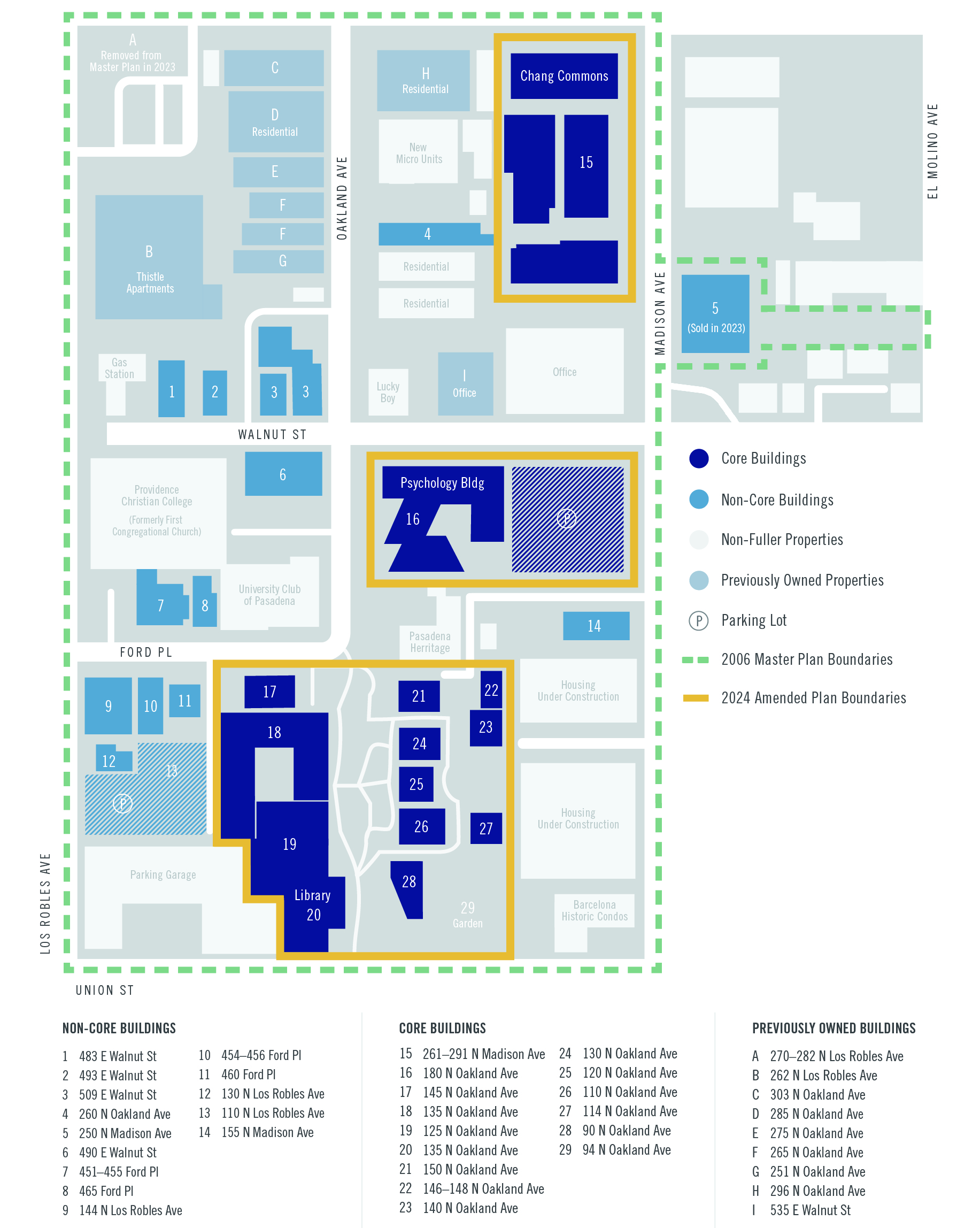
 The amended boundaries of the Master Plan incorporate only properties currently owned by Fuller that will provide a cohesive, consolidated campus.
Properties not controlled by Fuller, and those now considered non-core, are removed from within the plan boundaries.
Fuller has identified as core buildings those that serve a fundamental purpose, maintain an established central focus, and preserve the historic walkable spine of the campus.
Most of these buildings sit on N. Oakland Avenue and contribute to the Ford Place National Register District. Core buildings also include the Psychology Building on the corner of N. Oakland and Walnut Street, and Chang Commons apartments on Madison.
Non-core properties either currently do not provide essential operating functions or may need to be phased out as student population and programming evolve.
Many of the non-core sites were slated for new development under the prior Master Plan and therefore were never envisioned to be used in their current format. The projects approved for those sites in the prior plan have been eliminated. Multiple properties not owned by Fuller, but within plan boundaries, will also be released from Master Plan restrictions that constrain future development on those sites.
These amendments remove all non-core buildings from the Master Plan boundaries; however, the process of repurposing the properties will be gradual.
The approach to releasing properties will be related to campus needs. While some non-core buildings will be sold or leased or considered for joint ventures in the short term, Fuller does not anticipate phasing out others for many years, if at all. Rather than creating a significant change all at once, the Amended Master Plan seeks to create an envelope of opportunity as Fuller continues to adapt to changing conditions.
Amended Master Plan FAQs
Amended Master Plan Map