
Minding Our Gaps
Cultivating Courage and Mutuality in the Face of Power, Privilege, and Positionality
February 20-21, 2026
In person (Pasadena and Phoenix campuses) and online
Pricing
General Admission: $50
Ministry Leaders and Early-Career Professionals: $25.00
Fuller Students, Faculty, Staff: Free
Fuller Alumni: $25
Registration
A total of 6 continuing education (CE) credits are available for the symposium (each two-hour plenary session is worth 2 credits). CE credits are $10 per credit for Fuller alumni and $15 per credit for the general public. CE payments may be refunded with advance 24-hour notice to [email protected]. Course completion certificates will be awarded via email, in exchange for a completed evaluation survey following the course.
This course is for everyone from graduate-level students to working professionals, especially mental health professionals. To request accommodations for special needs, please email [email protected]. To obtain the grievance policy or report a grievance, please email [email protected] or call 626-584-5544.
Course meets the qualifications for up to six (6) hours of continuing education credit for LMFTs, LCSWs, LPCCs and/or LEPs as required by the California Board of Behavioral Sciences.
Fuller Theological Seminary, Graduate School of Psychology is approved by the American Psychological Association to sponsor continuing education for psychologists. Fuller Theological Seminary, Graduate School of Psychology maintains responsibility for this program and its content.
Fuller Theological Seminary, School of Psychology & Marriage and Family Therapy (Provider #1000085) is approved by the California Association of Marriage and Family Therapists to sponsor continuing education for LMFTs, LCSWs, LPCCs and LEPs. Fuller Theological Seminary, School of Psychology & Marriage and Family Therapy maintains responsibility for the program and all its content.
Para registrarse al evento en español, visite: Información de Registro
등록을 위해 한국어 이벤트 정보와 등록안내를 방문하세요: 등록 정보
Integration Symposium 2026
Our world confronts us with weighty challenges related to social location, including (but not limited to) culture, race, gender, class, and power. These experiences of difference show up in all aspects of our clinical and ministry contexts and have particular implications for the integration of psychology and theology. This year’s annual Integration Symposium will take place February 20 and 21, 2026 on the topic “Minding Our Gaps: Cultivating Courage and Mutuality in the Face of Power, Privilege, and Positionality.” Together we will seek to model a path of humility and courage as we engage the complexities of our lived experiences in various vocational settings.
Three different keynote presentations from a variety of presenters will embody the integrative challenges inherent to some of these gaps.
In the Friday morning keynote, Drs. Brad D. Strawn and Christin J. Fort will explore issues of power and privilege embedded in the gap between the disciplines of psychology and theology, tracing the history of integration and models that have emerged to mind the gap. Then, in partnership with the Fuller Music Collective, an embodied experiential example of integration in music and ministry will be offered that includes original, psychologically informed and theologically sound worship music. There will also be a Q&A with Fuller’s professor of integration and the writers and producer of the album.
On Friday afternoon, Drs. Jessica ChenFeng (Fuller) and Saul Barcelo (Loma Linda) will explore the concept of Nepantla. Nepantla, a Nahuatl word meaning "in the middle," was popularized by Chicana feminist scholar Gloria Anzaldúa and speaks to those who live in the borderlands. Nepantla offers a fluid and liberating framework in which complexity is honored and all can belong. Central to the presenters’ thesis is a theological claim that Jesus himself dwells in Nepantla: fully human and fully divine, an in-between figure who embodies radical hospitality toward the marginalized and displaced. For clinicians, pastors, chaplains, and ministry leaders working at the intersections of culture, faith, and healing, this framework offers vital tools for both personal reflection and professional practice. Participants will explore how to become nepantleras/os—facilitators who create spaces of belonging and liberation for those living in cultural, spiritual, and social borderlands.
The Saturday morning keynote will continue themes related to minding the gaps of power, privilege, and positionality in clinical and ministry spaces when working across differences. Drs. Strawn and Fort will offer a model of leaning into our clinical vulnerabilities and strengths related to culture in authentic ways in various contexts, grounded in the fact that differences between therapists/ministry leaders and clients/laypersons regarding race, class, gender, and so on inevitably present complex matters of power and privilege. These gaps may lead to therapeutic and relational impasses where imagination, meaning-making, relationality, and hope break down and may become extinguished. Together we will acknowledge the challenges and explore practical ways of working through the gaps to co-create authentic and lasting forms of meaningful engagement.
A number of different workshops will be presented by Fuller faculty, alumni, students and staff throughout Friday and Saturday afternoons.
Program
Plenary Session 1
The Original Integrative Gap: Psychology and Theology
This presentation will explore the history and challenges of the integration of psychology and theology, as well as some emergent models to facilitate disciplinary integration. An embodied experiential ministry example of integration will be shared that includes psychologically informed and theologically sound original worship music.
Learning Objectives
At the end of this session, participants will be able to:
- Articulate three challenges to the integration of psychology and theology
- Articulate three models of integration
- Describe an embodied process of integration within a clinical or ministry context
Plenary Session 2
The Integration of Nepantla: The In-Between as Whole
Migration—the movement of people and animals from one place to another—has been a part of creation history from the beginning. In our contemporary context, the term now bears much sociopolitical and cultural burden. Nepantla, a Nahuatl word meaning "in the middle," was popularized by Chicana feminist scholar Gloria Anzaldúa and speaks to those who live in these borderlands. These in-between spaces are intimately familiar to Latine and Asian American communities who share the experience of migration to the U.S., along with the painful reality of being marked as foreigner, other, and told to “go back to your country.” This presentation will examine how dominant U.S. discourses create rigid boundaries around identity, belonging, and citizenship, often marginalizing those who inhabit liminal spaces. In contrast, Nepantla offers a more fluid and liberating framework—one where complexity is honored and all can belong. Central to this exploration is the theological claim that Jesus himself dwells in Nepantla: fully human and fully divine, an in-between figure who embodies radical hospitality toward the marginalized and displaced. For clinicians, pastors, chaplains, and ministry leaders working at the intersections of culture, faith, and healing, this framework offers vital tools for both personal reflection and professional practice. Participants will explore how to become nepantleras/os—facilitators who create spaces of belonging and liberation for those living in cultural, spiritual, and social borderlands. Together, we will consider concrete practices and ministries that embody a God of the displaced and a refugee Jesus, applicable across contexts of worship, pastoral care, therapeutic work, teaching, and community organizing.
Learning Objectives
At the end of this session, participants will be able to:
- Describe Nepantla as in-between space, identifying its Nahuatl origins, its development in Gloria Anzaldúa’s work/scholarship and reflect how this concept informs/influences individuals’ identity, culture and spirituality
- Analyze how U.S. discourses can create rigid boundaries of identity and how Nepantla offers a more liberating framework where all can belong
- Apply a Nepantla-informed clinical approach by identifying how clients experience in-between spaces (culturally, spiritually, socially), developing case conceptualizations that honor rather than pathologize liminal identity, and implementing therapeutic interventions that create belonging and reduce internalized marginalization
Plenary Session 3
Leaning Into Our Cultural Vulnerabilities & Authenticities in Clinical & Ministerial Contexts
Differences between therapists/ministry leaders and clients/laypersons regarding race, class, gender, and so on inevitably present complex matters of power and privilege. These gaps may lead to therapeutic and relational impasses where imagination, meaning making, relationality, and hope break down and may become extinguished. This presentation will explore such challenges and suggest practical ways of working with these gaps. It will be posited that therapists and ministry leaders must lean into their own vulnerabilities as they navigate dynamics of power and privilege in order to mind and cross these gaps. To embrace one’s shame requires clinicians and persons in ministry contexts to explore their own social particularities and work toward self-differentiation to enhance openness, humility, and courage. Embracing our vulnerabilities as an antidote to defensiveness and the derailments of relationality, imagination, meaning making, and hope may repair relational ruptures and move us toward true mutual recognition.
Learning Objectives
At the end of this session, participants will be able to:
- Name three sources of interpersonal impasses, often rooted in larger cultural and systemic contexts, that may occur in clinical or ministry contexts
- Define and describe three ways to lean into one’s vulnerabilities with courage
- Describe the process of self-differentiation and name three areas of personal growth
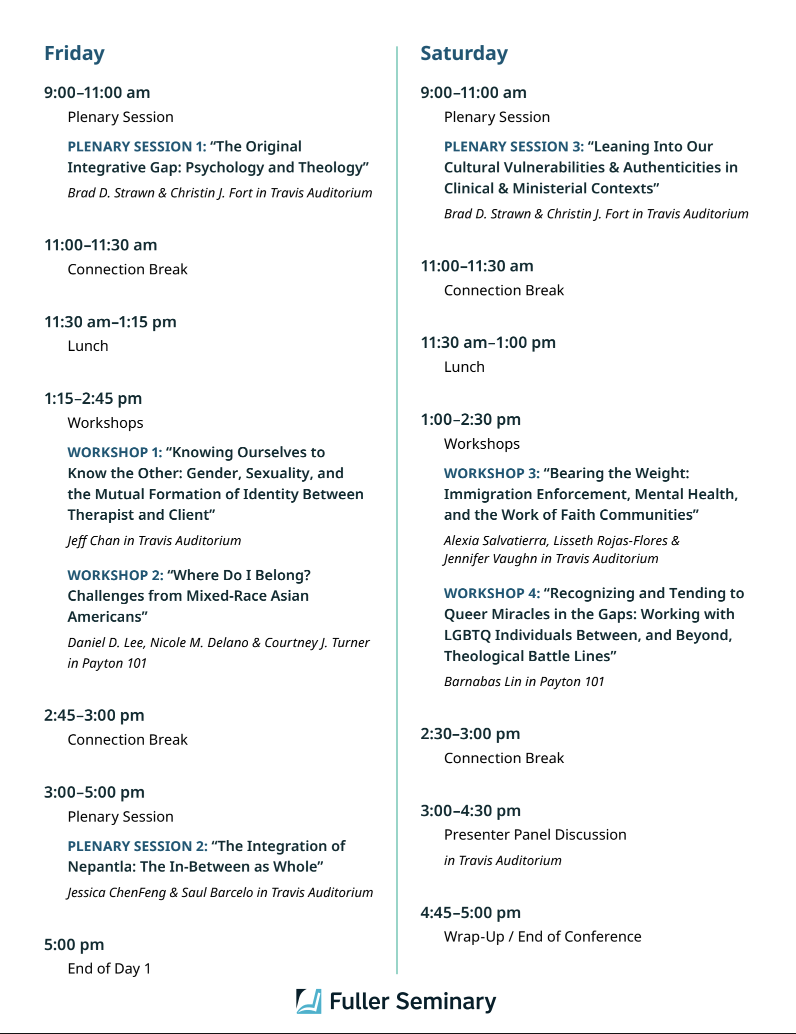
Download a PDF of the Schedule
Schedule
FRIDAY, FEBRUARY 20
9:00 am–11:00 am: Plenary Session 1 - The Original Integrative Gap: Psychology and Theology
11:00 am-11:30 am: Connecting Coffee
11:30–1:30 pm: Lunch
11:45 am–1:00 pm: Alumni Luncheon (alumni only), Pasadena Campus
Gather with Fuller alumni, staff, and faculty—including Dean Cynthia Eriksson, Jessica ChenFeng, Christin Fort, Brad Strawn, and Julie Tai—in person over lunch during the Integration Symposium. This casual gathering is an opportunity to connect in community, hear a brief update on Fuller from Cynthia Eriksson, and share conversation around the Integration Symposium. Learn more and register here (separate registration required).
1:30–3:00 pm: Workshops
Knowing Ourselves to Know the Other: Gender, Sexuality, and the Mutual Formation of Identity Between Therapist and Client - Dr. Jeff Chan (Travis Auditorium & Live Stream)
Where Do I Belong? Challenges from Mixed-Race Asian Americans - Fuller's Asian American Center (Payton 101 & Live Stream)
3:00–5:00 pm: Plenary Session 2 - The Integration of Nepantla: The In-Between as Whole
SATURDAY, FEBRUARY 21
9:00 am–11:00 am: Plenary Session 3 - Leaning Into Our Cultural Vulnerabilities & Authenticities in Clinical & Ministerial Contexts
11:30-1:00: Lunch
1:00-2:30: Workshops
Recognizing and Tending to Queer Miracles in the Gaps: Working with LGBTQ Individuals Between, and Beyond, Theological Battle Lines - Barnabas Lin, MDiv (Payton 101 & Live Stream)
Bearing the Weight: Immigration Enforcement, Mental Health, and the Work of Faith Communities - Fuller's Centro Latino (Travis Auditorium)
2:30-3:00: Break
3:00–4:30 pm: Workshops
4:45-5:00: Wrap up
2026 Integration Symposium Workshops
Knowing Ourselves to Know the Other: Gender, Sexuality, and the Mutual Formation of Identity Between Therapist and Client
Travis Auditorium & Live Stream
Abstract
This presentation explores how therapists can engage authentically across differences of gender and sexual orientation using an I/Thou framework (à la Martin Buber) of relationship. Integrating theology and psychology, it emphasizes the role of curiosity, humility, and self-awareness in the Person of the Therapist, alongside a growing cultural understanding of the Person of the Client. The presentation invites clinicians at all levels of experience to consider how presence, identity, and encounter shape healing, even when these topics feel unfamiliar or challenging.
Presenter
Jeff Chan (né Creely; PhD) is a clinical psychologist whose work often sits at the intersection of identity, faith, and culture. Drawing on training in both clinical psychology and theology, he specializes in working with LGBTQIA+ individuals and couples navigating identity, shame, attachment, and religious conflict. Jeff has provided training on LGBTQIA+ clinical care within Christian institutions, serves as a clinical supervisor, and maintains a private practice in West Hollywood, California, focused on depth-oriented, humanistic, and relational psychotherapy.
Where Do I Belong? Challenges from Mixed-Race Asian Americans
Payton 101 & Live Stream
Abstract
Despite being one of the fastest-growing racial groups in the United States, mixed-race individuals face distinct challenges in racial identity formation that are often overlooked within monoracial frameworks. Drawing from psychological and theological perspectives, as well as lived experience, this workshop will explore how mixed-race Asian Americans navigate belonging, visibility, and racial categorization. The workshop will also consider broader implications for the church and clinicians, particularly in relation to inclusion, integration, and culturally responsive pastoral and clinical care.
Fuller’s Asian American Center - Fuller’s Asian American Center (AAC) exists to research, equip, and resource the Asian American church. We train and support Asian American leaders and non-Asian Americans who will work with Asian Americans. We help Asian American students of East, Southeast, and South Asian descent, including multiracial individuals and adoptees, ground their life and work in over 170 years of Asian American history and the particular spiritual and psychological concerns, needs, and challenges of our community.
Presenters
- Daniel D. Lee (PhD) is the academic dean of the Asian American Center and associate professor of theology and Asian American studies at Fuller Seminary. His research focuses on the Reformed tradition, theological contextuality, Asian American theology, and integration of theology and psychology. He serves as the theologian-in-residence at CitizensLA Church.
- Nicole M. Delano (MA) is a PhD candidate in clinical psychology at Fuller Seminary. Her research and clinical work focus on culturally informed neuropsychological assessment across the lifespan. She is currently a research fellow for the Neuropsychology and Resilience Lab and is completing her pre-internship at Cedars-Sinai/California Rehabilitation Institute.
- Courtney J. Turner (MDiv; PhD in ICS Student) is chair of the Department of Global Studies and assistant professor of missions and global studies at Southern Nazarene University. She is a PhD student in intercultural studies at Fuller Theological Seminary and a research fellow in formation and mixed-race studies with Fuller’s Asian American Center.
Recognizing and Tending to Queer Miracles in the Gaps: Working with LGBTQ Individuals Between, and Beyond, Theological Battle Lines
Payton 101 & Live Stream
Abstract
Pushing beyond the dominant question: “What theological side are you on re: gender identity, sexuality, and marriage?”, this workshop articulates, instead, a gift that maturing LGBTQ life offers regardless of theological side; a gift greatly needed by all. This workshop equips attendees to first understand and recognize the miracle that grows between theological sides, and then equips attendees to tend to it, whether as ministers or therapists. Specifically, attendees will be equipped to identify a few common mistakes to avoid, provided with a metaphor to work with, and offered a foundational theological posture needed for tending to the durable peace that grows in the gaps between violent polarities.
Presenter
Barnabas Lin (MDiv) is a facilitator and minister with experience discussing sexuality across the theological spectrum. Committed to centering LGBTQ flourishing over positional debates, he equips practitioners to nurture truly life-giving spaces. Barnabas serves as the theologian-in-residence at Bethel Community Presbyterian Church, is completing a PhD in theology, and works with Christians for Social Action’s Oriented to Love dialogue program.
Bearing the Weight: Immigration Enforcement, Mental Health, and the Work of Faith Communities
Travis Auditorium
Abstract
Latino/a communities are suffering from the weight of a mass deportation campaign that violates due process and separates families who have been in the US for decades. The psychological and spiritual impact is devastating. Psychologists, researchers and scholar-practitioners, Lisseth Rojas Flores and Jennifer Vaughn, will share the results of their research and efforts to equip faith leaders with trauma-informed practices to support congregants while preventing burnout and compassion fatigue. Missiology and ministry scholar-practitioners from Centro Latino will present the spectrum of effective pastoral and missional responses on the ground in Latino/a church networks throughout the US.
Fuller’s Centro Latino - Since 1974, Centro Latino has provided the global Latino church with transformative theological education. With a focus on holistic mission, the Latino Center offers a diverse range of high-quality educational programs deeply rooted in Christ and the work of the Holy Spirit. Our programs continually strive to address the specific realities of the global Latino community from the perspective of Christian faith. We provide practical tools and opportunities for critical reflection to foster adaptive leadership dedicated to serving the kingdom of God.
Presenters
- Alexia Salvatierra (PhD) - Academic Dean for Centro Latino and Associate Professor of Mission and Global Transformation. Salvatierra serves as academic dean for Centro Latino, where she is the founding developer and coordinator of the Diplomado en la Respuesta de la Iglesia a la Crisis Migratoria (Professional Certificate in the Church’s Response to the Immigration Crisis). Salvatierra is best known for her local, national, and international church and community leadership. Ordained as a Lutheran pastor in 1988, she has pastored English- and Spanish-speaking congregations.
- Lisseth Rojas-Flores (PhD) - Professor of Clinical Psychology, Department of Doctoral Psychology at Fuller Theological Seminary. Rojas-Flores’s research centers on immigrant children’s well-being with particular focus on how trauma, community violence, and socio-structural adversity impacts the child and family unit. Rojas-Flores’s teaching, research, and scholarship are deeply informed by culture, context, developmental science, and research-practice partnerships with legal, advocacy, and faith-based organizations.
- Jennifer Vaughn (MFT) - Vaughn is a bilingual licensed marriage and family therapist with over ten years of experience working with children, adolescents, and adults. As a Latina child of immigrants, she understands the unique struggles faced by individuals from immigrant families and recognizes that seeking therapy can be intimidating and anxiety-provoking. As an assistant professor at Pepperdine University, she conducts research that aims to address health disparities in children of immigrants, advance the understanding of effective programmatic support for development, and inform public policy. Her current and ongoing projects include analysis of the conditions contributing to health disparities among preschool-aged children of immigrants and an implementation study of a faith-based, trauma-informed intervention to increase faith leaders’ capacity to support congregants impacted by immigration enforcement and COVID-19.
- Carlos Cevallos (PhD) - Cevallos is the director of Centro Latino at Fuller Seminary. He is a member of the pastoral team at the Eagle Rock Evangelical Covenant Church and is an ordained minister with the Evangelical Covenant Church. For more than two decades, he has been actively engaged in theological training in the United States and Latin America, where he has taught at a variety of theological institutions and developed a wide range of research projects. Additionally, he has developed resources for Christian educators and pastoral ministry.
Save the Date
Join us next year for the 2027 Integration Symposium February 19—20, 2027.
Sign up here to stay informed.